
Quick answer: Whether an event is fully virtual, hybrid, or entirely in-person, the same five planning fundamentals determine whether it actually works: a clear purpose driving every format decision, sustained and cross-platform promotion, genuine accessibility and interactivity for attendees, a start time chosen around the actual audience's schedule, and a full rehearsal before the real thing. What changes between formats is execution detail, not the underlying planning discipline.
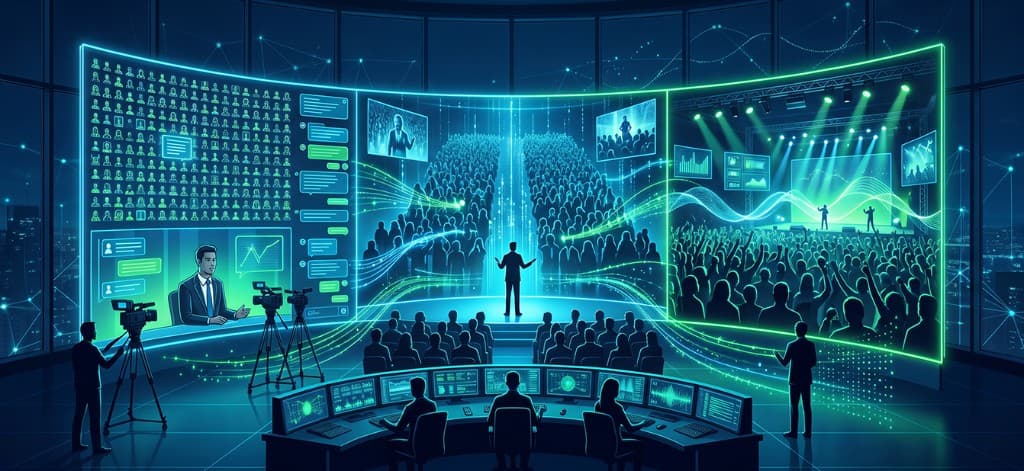
Events remain one of the most effective ways to build genuine engagement with an audience — but "event" now covers a much wider range of formats than it did a few years ago. Fully virtual events, hybrid setups combining an in-person audience with a livestreamed one, and traditional in-person gatherings each have real trade-offs. Here's how to plan any of them well, and how to choose between formats in the first place.
Key Takeaways:
- Purpose should drive format — not the other way around.
- Promotion has to be sustained and cross-platform, including live during the event.
- Accessibility and real interactivity beat a one-way broadcast.
- Time the event around the audience, then rehearse the full run.
- Hybrid fails when the livestream is treated as an afterthought.
What changes between formats is execution detail, not the underlying planning discipline.
Five Principles That Apply to Every Event Format.
1. Understand the Purpose Before Choosing a Format.
Events aren't one-size-fits-all — a product launch, an industry conference, an award ceremony, and an internal team gathering all call for different structures entirely. Before deciding on format or platform, get clear on the actual questions: Who is this event genuinely for? What does the audience need to walk away with? What's the single most important outcome — leads, brand awareness, community building, or something else? The answers should drive every downstream decision, including whether the event should be virtual, hybrid, or in-person at all.
2. Promote Relentlessly, Not Just Once.
A single announcement rarely fills a room — physical or virtual. Effective promotion is sustained, cross-platform, and reinforced as the date approaches: social posts, email reminders, partner cross-promotion, and — critically — live promotion during the event itself (real-time posts, stories, and updates that create momentum and pull in last-minute attendees). For public or hybrid events, promoting across every platform the target audience actually uses matters more than concentrating effort on just one.
3. Build in Real Accessibility and Interactivity.
An event that people can't easily join, or that gives them nothing to do but watch, underperforms regardless of format. For virtual and hybrid events, that means accounting for different devices, connectivity levels, and time zones for a geographically spread audience. For every format, it means giving attendees a genuine way to participate — live Q&A, chat, polls, or in-person interaction — rather than a one-directional broadcast. Interactivity is what turns passive attendance into actual engagement.
4. Choose Timing Around the Audience, Not Convenience.
Timing is easy to underestimate, especially for virtual or hybrid formats where there's no physical commute forcing attendance at a fixed hour. Study platform and audience analytics — when is the target audience actually available and receptive, not just technically free? A weekend slot might work for a consumer audience and fail entirely for a B2B one. Getting this wrong quietly caps attendance regardless of how good the content is.
5. Rehearse Before the Real Thing.
Technical and logistical issues are far easier to catch in a full rehearsal than live in front of an audience — connectivity problems, software bugs, unclear transitions between segments, or hybrid-specific issues like audio sync between an in-person room and a livestream feed. A tight rehearsal schedule, ideally informed by lessons from comparable past events, keeps live hiccups to a minimum.
Choosing the Right Format: Virtual, Hybrid, or In-Person.
Virtual works best when the priority is maximum reach with minimum cost and logistical overhead — a geographically dispersed audience, a lower budget, or content that doesn't depend on physical interaction to land well.
In-person works best when the goal is deep relationship-building, high-value networking, or an experience that genuinely benefits from physical presence — a product launch meant to generate real buzz, a high-touch client event, or anything where the room itself is part of the value.
Hybrid captures both audiences at once but adds real complexity — it requires planning two experiences simultaneously (the in-room one and the livestream one) rather than treating the virtual feed as an afterthought bolted onto an in-person event. Done well, it extends reach significantly; done poorly, it under-serves both audiences at once.
Frequently Asked Questions.
Are virtual events still worth hosting in 2026? Yes, particularly for maximizing reach at lower cost, or reaching a geographically dispersed audience that couldn't attend in person regardless of format.
What's the biggest mistake organizers make with hybrid events? Treating the virtual audience as secondary — designing entirely for the room and adding a livestream as an afterthought, which produces a weak experience for remote attendees specifically.
How far in advance should event promotion start? It depends on the event's scale, but sustained promotion beats a single announcement regardless of format — building awareness gradually, then intensifying as the date approaches, consistently outperforms a one-time push.
Is a rehearsal really necessary for a smaller event? Yes — technical and logistical issues (connectivity, transitions, timing) are common at any scale, and catching them in rehearsal is far less costly than catching them live.
How do you choose the right time to host an event? Base it on actual audience behavior data from past events or platform analytics, not assumption — the right time depends heavily on the specific audience's schedule and format.
The Bottom Line.
Whatever format fits your goals, Mystic Advertising's Event Management team plans and executes virtual, hybrid, and in-person events end to end — from format strategy through live-day production.