
Quick answer: Digital Out-of-Home (DOOH) advertising — digital billboards and screens that can change content instantly — offers far more flexibility, targeting data, and interactivity than traditional static Out-of-Home (OOH) advertising, at a comparable or lower long-term cost once content needs to change more than once. OOH still holds real value for long-running, simple brand messages in high-traffic locations where a static, always-on presence matters more than dynamic content. In Dubai specifically — home to some of the world's most recognizable digital advertising landmarks — DOOH has become a serious channel, not a novelty.
Outdoor advertising has always been about capturing attention in physical space. What's changed is how dynamic that space can now be. Anyone who's driven down Sheikh Zayed Road or looked up at the Burj Khalifa after dark has seen Digital Out-of-Home advertising in action — content that updates in real time, in a way a traditional printed billboard simply can't.
Key Takeaways:
- DOOH can update in minutes; traditional OOH needs a reprint every change.
- Dubai — SZR, Burj Khalifa, Museum of the Future — is already core DOOH infrastructure.
- DOOH wins on flexibility, rotation, interactivity, and measurement.
- Static OOH still fits long-running, simple brand messages in prime locations.
- Programmatic DOOH is lowering the barrier for smaller brands.
In Dubai, DOOH isn't a novelty — it's already how the city itself communicates.
What Is DOOH?.
Digital Out-of-Home advertising uses digital screens and displays — rather than printed materials — to show video, animation, and dynamic content in public spaces. Unlike traditional OOH, a DOOH message can be updated in minutes rather than requiring a physical reprint and reinstallation, and can even sync with mobile devices, weather, time of day, or live data feeds.
DOOH in Dubai: A Genuinely World-Leading Market.
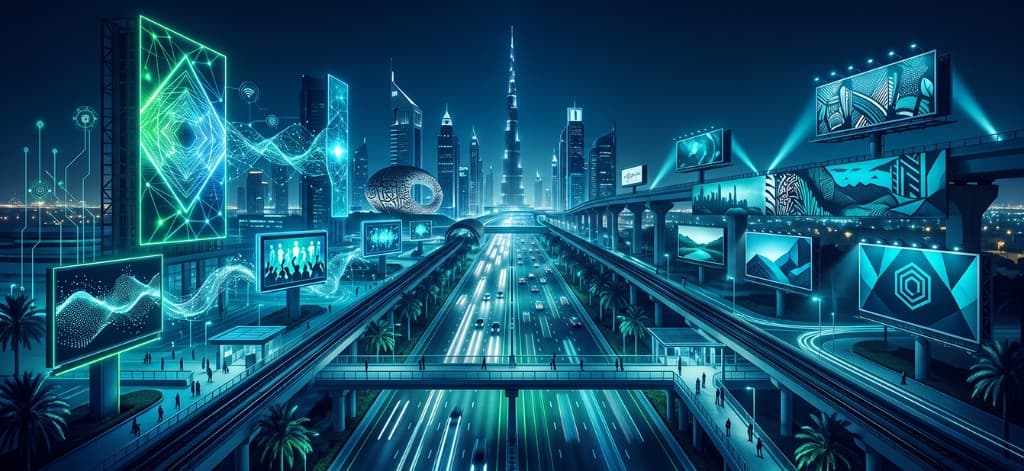
Dubai isn't just a participant in DOOH — it's one of its most visible global showcases. The Museum of the Future's Arabic-calligraphy facade, the Burj Khalifa's LED display (used for everything from brand campaigns to national celebrations), and the dense corridor of digital billboards along Sheikh Zayed Road all put DOOH directly in front of both residents and the high volume of international visitors passing through the city. For brands advertising in the UAE, this isn't a channel to consider someday — it's already core infrastructure in how the city itself communicates.
DOOH vs. OOH: The Real Differences.
Message Flexibility.
DOOH content can be updated in minutes through software, without reprinting or reinstalling anything physically. Traditional OOH requires new printed materials and manual installation every time a message changes — a process that can take days and involves real labor cost each time. For any campaign that needs to respond to trends, promotions, or real-time events, DOOH is the clear advantage.
Interactivity and Engagement.
DOOH supports video, animation, and audio — formats that consistently drive higher engagement than a static image, particularly with audiences already accustomed to dynamic digital content everywhere else in their day. Traditional OOH remains fully static; the same image runs until it's physically replaced, which can lead to message fatigue among people who pass the same billboard regularly.
Running Multiple Campaigns.
Digital screens can rotate between multiple advertisers or messages on the same physical unit, making DOOH inventory more efficient for media owners and often more affordable for brands to access prime locations. A traditional OOH billboard can only display one message at a time, limiting a given location to a single advertiser for the full booking period.
Data and Targeting.
DOOH's biggest structural advantage: because it's technology-driven, it can capture far more detailed audience and performance data than traditional OOH — foot traffic patterns, time-of-day performance, even anonymized audience demographics in more advanced installations. This makes it far easier to measure DOOH campaign performance than a traditional billboard, which offers essentially no direct feedback loop.
Which One Should a Brand Actually Choose?.
Choose DOOH for campaigns that benefit from frequent updates, real-time relevance, or measurable performance data — product launches, promotions with defined windows, or any campaign where the message needs to evolve during its run.
Choose traditional OOH for a simple, long-running brand message in a high-traffic location, where a static, consistently visible presence matters more than dynamic content — brand awareness campaigns with a long single message and a generous budget for prime, permanent placement.
Consider both together. Many effective outdoor campaigns in Dubai combine a strong static OOH presence for baseline visibility with DOOH placements for time-sensitive or higher-engagement messaging — the two aren't mutually exclusive.
What's Next for DOOH.
Programmatic DOOH (pDOOH) — buying digital out-of-home inventory through automated, data-driven platforms similar to programmatic digital advertising — is increasingly available in major markets including the UAE, letting brands target by time, weather, or audience data with far more precision than a traditional media buy.
AI-driven content personalization is beginning to let DOOH screens adjust creative in near-real-time based on factors like weather, traffic conditions, or time of day — extending the same "right message, right moment" logic that's long defined digital advertising into physical space.
Frequently Asked Questions.
Is DOOH more expensive than traditional OOH? It depends on campaign length and how often content needs to change. A single long-running static message can be cheaper as pure OOH; a campaign needing frequent updates is usually more cost-effective as DOOH once the labor cost of reprinting traditional billboards is factored in.
Where is DOOH most visible in Dubai? Sheikh Zayed Road's digital billboard corridor, the Burj Khalifa's LED facade, and the Museum of the Future are among the most prominent examples, alongside a growing number of digital screens across malls and transit hubs.
Can DOOH campaigns be measured the way digital ads are? More so than traditional OOH, yes — DOOH platforms can track factors like play counts, time-of-day performance, and in some cases anonymized audience data, though measurement still isn't as granular as fully digital channels like search or social.
Does DOOH make sense for a smaller local business, or only major brands? Increasingly the former too — programmatic DOOH platforms have lowered the barrier to entry, letting smaller brands buy targeted slots rather than requiring a large, long-term media commitment.
Is traditional OOH becoming obsolete? No — it remains cost-effective for long-running, simple messaging in high-traffic locations, and some placements (particularly iconic, permanent locations) still favor a static, always-on presence over rotating digital content.
The Bottom Line.
Whether the right fit is DOOH, traditional OOH, or a combination of both, Mystic Advertising's Outdoor Marketing team can help plan and place campaigns across Dubai's outdoor advertising landscape.