
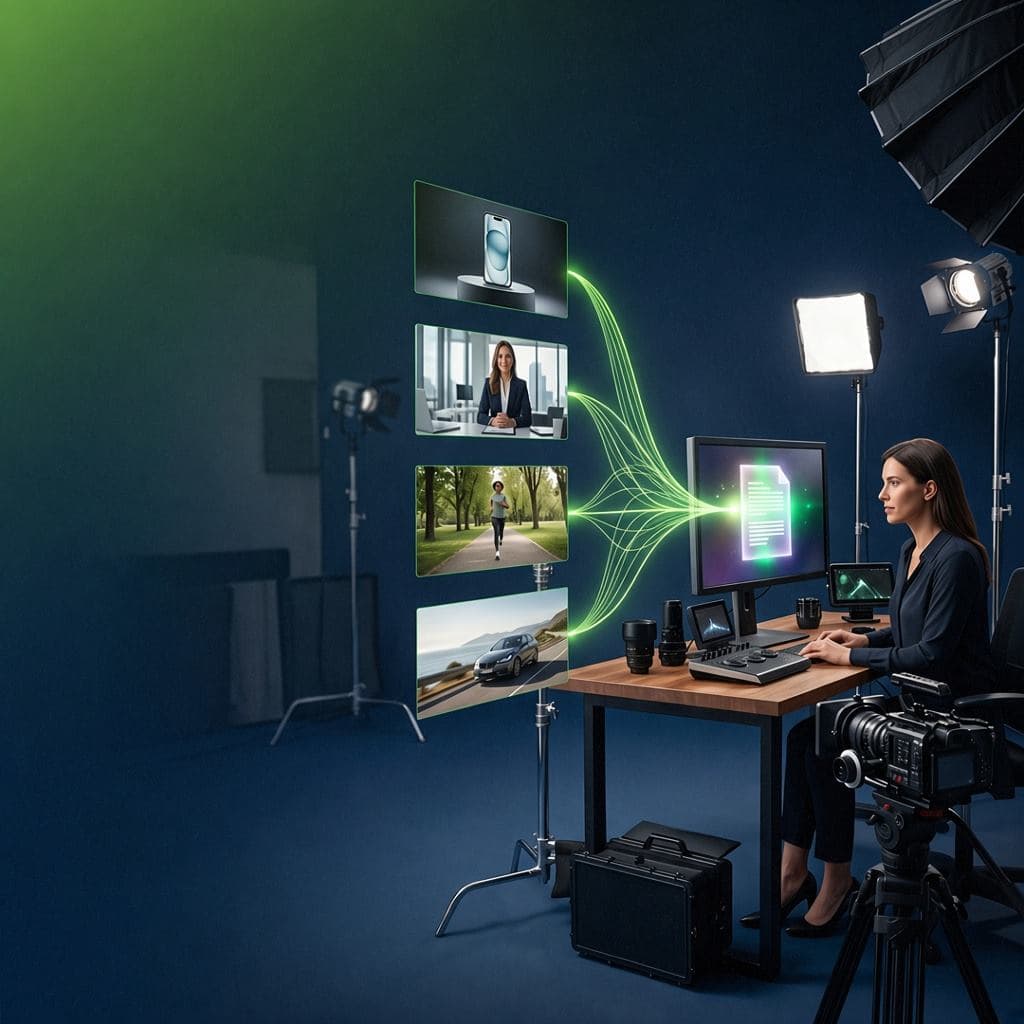
Six months ago, ranking meant a blue link on page one. Today a growing share of future customers ask ChatGPT to compare agencies, ask AI Overviews to summarize options, or ask Perplexity to recommend a video production partner in Dubai. Video sits at the center of this shift. AI systems don't watch pixels the way a human does — they read transcripts, captions, structured data, and on-page context.
Prompt-driven video marketing is the discipline of building that surrounding content deliberately. At Mystic it sits at the intersection of Mystic Studio production and AEO/GEO through the SEO team. Companion reads: GEO vs SEO 2026, and the headless architecture guide.
Key Takeaways:
- Start from the prompt someone will type into an AI assistant, not from the camera.
- A full, edited transcript on the page is the highest-impact AI asset.
- VideoObject plus FAQPage schema makes videos extractable instead of inferred.
- Older videos can be optimized without a reshoot.
- Measure AI referrals and citation checks, not only views and watch time.
A beautifully produced video with no transcript, no schema, and a generic filename is functionally invisible to AI search, no matter how good the production value is.
What Prompt-Driven Actually Means.
- Scripting uses the phrasing people type into AI tools: best, top, vs, how to choose, worth it.
- Titles and descriptions are written as direct answers, not teasers.
- Transcripts become a primary SEO asset, not an accessibility afterthought.
- Structured data tells crawlers what the video is, who made it, and why it's authoritative.
Why AI Search Engines Ignore Most Video Content.
- No machine-readable transcript — spoken content exists only as audio.
- Thin metadata: titles like "Company Video 3" give no distinguishing signal.
- Missing VideoObject schema, so systems have to infer context and often skip you.
The Five-Part Framework.
1. Prompt mapping before scripting. Map comparison, how-to-choose, and location-specific prompts ("best real estate videographer in Business Bay"). 2. Structured, citable scripting — specific numbers and named comparisons, not vague brand language. 3. Transcript-first publishing as on-page copy with headers. 4. VideoObject and FAQPage schema, including an embedded transcript field. 5. AI crawler access via robots.txt and llms.txt.
What This Looks Like for a Dubai-Based Brand.
A developer posting "Project Name — Official Video" is optimized for browsing. A prompt-driven walkthrough answers "best off-plan apartments in Business Bay under AED 2 million," ships a transcript under those questions, and tags VideoObject with developer, location, and unit types. Production value may barely change. Recommendability does.
How to Measure Whether It's Working.
- Segment referral traffic from chatgpt.com and perplexity.ai.
- Periodically prompt target queries and record whether the brand or video appears.
- Watch Search Console impressions with declining clicks — often a sign of AI Overviews.
- Keep VideoObject and FAQPage markup valid after site updates.
Frequently Asked Questions.
Do I need a full transcript for every video? Yes. AI crawlers parse text, not pixels. An accurate transcript on the page is the single highest-impact change.
Can older videos be optimized without reshooting? In most cases yes: transcript, direct-answer titles, schema, and crawler access.
Where to Start.
A library built before AI search existed does not need to be reshot — it needs to be re-contextualized. Mystic handles production and AI search strategy under one roof so video is planned to be found, not just watched.